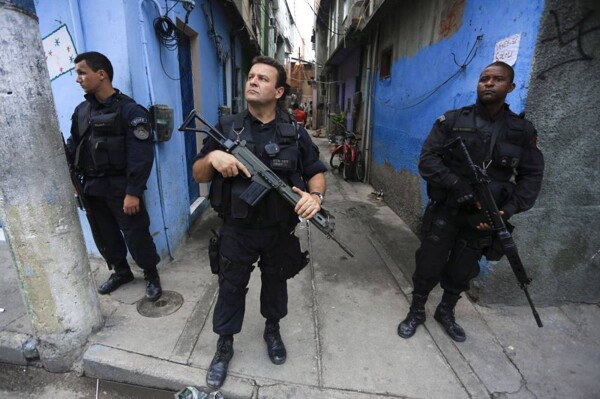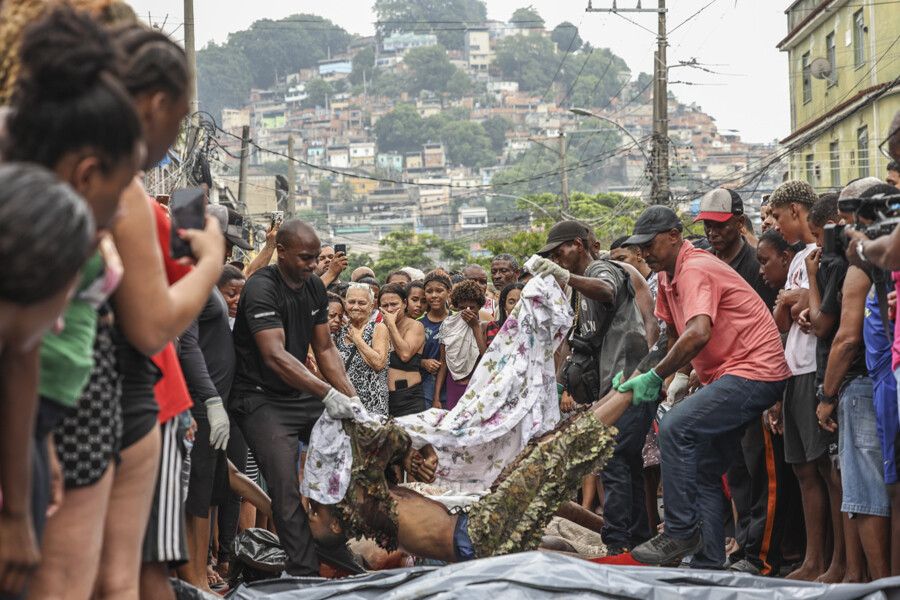
Residents of Rio de Janeiro recovered dozens of bodies on Wednesday following a massive police operation launched the day before against Comando Vermelho, one of Brazil's largest drug trafficking gangs. The death toll has reached 132, according to figures from the Public Defender's office, a public institution that collected data from forensic institutes and the crime scene, although the regional government has only confirmed 119 so far. Among the dead are four police officers, and the rest, according to authorities, are suspects believed to be members of the armed gang that offered resistance. The operation took place on Tuesday in the favela complexes of Penha and Alemao, a poor area where 200,000 people live, and the clashes spread into a wooded area in the hills bordering these neighborhoods. Those forests were found riddled with bullet-riddled bodies on Wednesday morning. Favela residents mobilized to search for their relatives, and without authorities' help, they entered the forest at dawn to recover the bodies on makeshift stretchers. A woman cries over bodies in a street on Wednesday, in Rio de Janeiro (Brazil). EFE/ André Coelho The bodies were laid out early in the morning in a row of at least 50 people, lying side by side, in the Sao Lucas square, in Penha, in view of relatives, onlookers, and a few journalists. Forensic service vans were gradually taking the deceased away. Rayune Diaz Ferreira, one of the community's residents, is searching for her cousin and is outraged by an unprecedented police operation. «The state abandoned us a long time ago and has abandoned us again,» she said. EFE/ André Coelho This view was backed by all of Rio's police leadership, which offered details of the operation, planned for a year and which, according to them, aimed to arrest 180 alleged drug traffickers. Rio's Civil Police Secretary, Felipe Curi, stated that it was planned to corner the drug traffickers to force them to take refuge in the wooded area, in order to reduce the risk of civilian casualties. Curi affirmed that the action was «legitimate» and attacked the organizations and politicians who have questioned it, calling them «narco-activists». Simultaneously, Brazil's Minister of Justice, Ricardo Lewandowski, questioned the legality of the operation before boarding a flight to Rio de Janeiro, where he is expected to address the situation with local authorities. Lewandowski said that President Luiz Inacio Lula da Silva was «appalled» by the number of deaths and «surprised» not to have received prior notice of the operation from the Rio de Janeiro regional authorities. «The operation was extremely brutal, especially violent,» he said. Others on motorcycles, dressed in civilian clothes, also with rifles, were giving instructions to volunteers to collect the bodies of some of the gang members. Photo EFE The publication «Rio de Janeiro: over a hundred dead in its most brutal operation» was first published in La Verdad Panamá. The High Commissioner Volker Turk urged that investigations be conducted into the deaths and reminded Brazilian authorities «their obligations under international law». Nevertheless, the governor of the state of Rio de Janeiro, Claudio Castro, politically responsible for the intervention, said it was a «success». A woman cries over a body in a street on Wednesday, in Rio de Janeiro (Brazil). «In this massacre, we residents are the ones who carry the bodies. They left the bodies there, in the woods, and the residents spent the whole night, without sleeping or eating, searching and carrying corpses non-stop,» she told EFE. Criticism of the operation The United Nations Office for the Human Rights said it was «horrified» by the operation. «We will see if it is compatible with a democratic state of law,» the head of Justice said. A war of numbers The official death toll, 119, clashes with the figures from the Public Defender's office, which raises it to 132, and with the count made by journalists at the scene, who also noted a higher number of dead. Separately, 113 suspects were arrested and 10 teenagers were taken into police custody, 119 weapons and 14 explosive devices were seized, and tons of drugs were confiscated. Curi said this was «the biggest blow» dealt to Comando Vermelho since the organization's origin in the seventies, and highlighted that it occurred at «the nerve center» of this gang, which has tentacles throughout Brazil and in some neighboring countries. On Wednesday, after the police had withdrawn, some members of Comando Vermelho were again roaming the streets of the favela, as confirmed by EFE. Some were on foot, armed and dressed head-to-toe in black with balaclavas.